
Border is a 2018 horror film directed by Ali Abbasi and starring Eva Melander as Tina, a gifted security specialist. As a customs inspector, Tina uses her ability to smell human emotions to determine who needs closer scrutiny. One day, she is flummoxed by a man she cannot smell, Vore, played by Eero Milonoff. While not an easy watch, it made for a satisfying puzzle of identity; one that resists categorization.
All else is a spoiler. Go watch it first!
The Observer
The film begins not with conflict but with observation. Tina watches a cricket before deciding on gentle interaction, suggesting she is a steward of the natural world. This delicate moment is purposeful, guided by Abbasi. In contemporary storytelling, this microcosm of Tina’s life suggests the greater shape of what’s to come. She responds to the cricket, and it is receptive of her, all within the shadow of the shipyard where she is employed.
Following her to work, we see Tina inspect travelers. She observes them as she does with the cricket, smelling them from a distance as they pass. Tina smells their day-to-day anxieties, their nerves, and their fears. The scent carries to her almost through synesthesia, as the smell translates directly into the inner monologue of those she encounters. Periodically, a smell will tip her off and she’ll ask a traveler to submit their luggage for inspection. These requests are made with care, but she is not met in kind. Travelers think the worst of her, mentally calling her monstrous names. She receives these unflinchingly. Tina is undoubtedly good at her job.
She returns home to an environment that is hostile towards her, neither ill intent nor grace. Dogs bark wildly, and her partner barely interacts with her. It would be a daily unsettling to return home. Understandably, Tina chooses a walk in the woods, removes her shoes, and breathes. She interacts with the landscape, the creatures within it, and these woods interact with her. It would seem, this is distinctly her natural setting. Although, the animals are at times skittish. At first, it’s unclear if she belongs in either setting, but in time the forest fox warms up to her.
The steward theme is carried further as Tina shepherds a pregnant woman to the hospital, allowing the deer to cross along the way. Not firmly in a rush for the woman or the deer. She holds the space between. When arriving at the hospital, the family rushes inside while thanking her. The doors closed in Tina’s face. For a moment she is stunned before easing into a long drive home.
Tina is a humane observer with marked delicacy, treating the cricket with care and the humans with leniency. An observer of the natural world and a surveiller of the human – both of which imply an outsideness. Sometimes misattunement is exile.
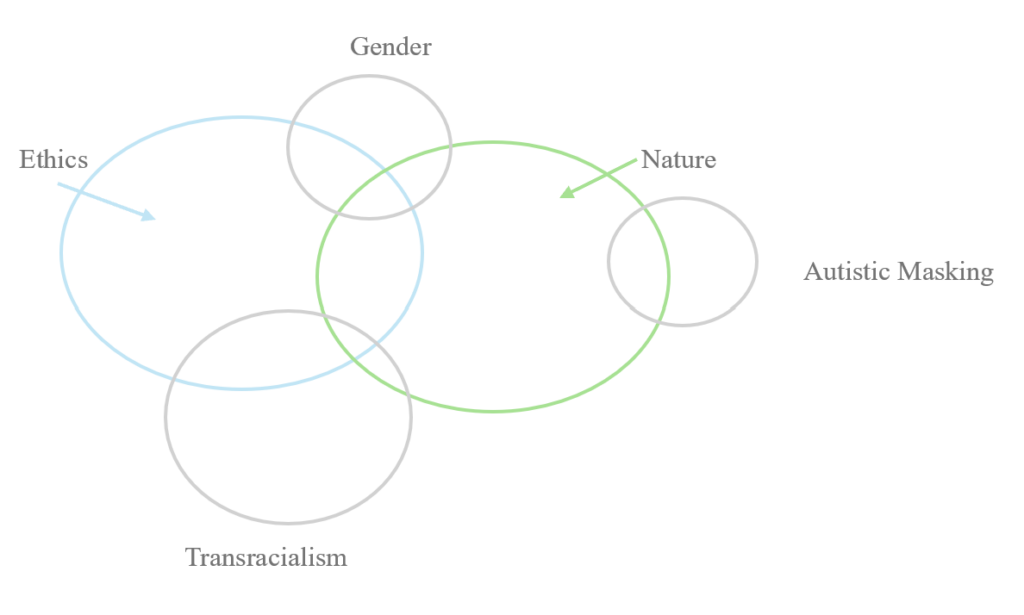
Tina/Reva’s Distributed Identity Across Systems
Smell as Moral Epistemology
At her place of employment, Tina meets a man she can’t smell, Vore. She keeps sniffing at apparently nothing, reading at first as confusion, then as something more. When she continues to be unable to smell him, his motives are unclear to her. Due to the security nature of her work, an unclear motive is as good as a guilty one. She requests a strip search to be conducted. Without scent, she has no filter for whether he is “good” or “bad.” He simply is. When the search is complete and he is found innocent of possession, she accepts the human filter of innocence.
On another man, Tina sniffs out a microchip of child sexual abuse material. This chip is linked to a greater web of child abuse. The investigation lead asks Tina directly if it is possible to smell what people are feeling. And to Tina it is. Tina can smell shame, guilt, rage, and an array of other things too.
Unfortunately, without evidence linking the chip to the web, the police can’t do anything. A procedural fumble. A fumble implying humanity as a system experiences, a bureaucratic morality, rather than Tina’s embodied one. This is probably something the audience can relate to — to feel singular within a mass, but Tina is not within the mass. She’s on the border of it.
Tina’s use of smell isn’t just a sense for perceiving the world, it is a function of morality. She smells the emotions through a Troll’s body but perceives them through a human moral framework. Unlike typical Trolls, her use of smell distinguishes between “good” and “bad,” creating an embodied ethical system. Again, another border.
From Human Ethics to Troll Identity
Prior to adopting a Troll identity, Tina lives as a human. She abides by human laws, human morals, human norms. She experiences a life out of sync through differences she feels but cannot express. Her use of smell, a tool, her face a liability. Then she is told she is a Troll. The context of her existence emerges.
Upon receiving this new identity, she is shunned. Her father calls her evil, his nurse shields him from her. She flees to mourn, cradled by the earth. When she is told she is a Troll, she is with Vore, but when she faces the implications, she is alone. She cries out and the forest receives her.
Tina’s strength becomes brutish, self-protective, territorial. But also natural. Her differences are no longer a mark of shame, instead a mark of the natural world. As a Troll she has new dimension, instead of correcting her or narrowing her focus, this identity expands her.
Genocide and Assimilation
The end of the film reveals Tina’s heartbreaking history. Trolls were indigenous to Sweden, kidnapped by humans, subject to experimentation, and killed. Institutional concealment and bodies in mass, unmarked graves shroud the remains of her family. Border is a story of genocide and colonialism. Reva the troll becomes Tina the human, not by choice but by force, dominance, and lies. There was no choice or autonomy.
Tina is forced to assimilate in other ways too. Her partner attempts sexual contact which feels painful to her. What appears human does not align with her physiology, destabilizing assumptions about sex, reproduction, and normativity. Meanwhile, her lover, Vore, has her complement and later gives birth to their child.
Further, assimilation occurs. Tina’s flat affect and sensory sensitivity could be interpreted as autist. There is no read where Tina is a cishet, neurotypical, human-normative woman. She simply presents this the best she can. So surely, she is a Troll. But even that is incomplete.
Troll Ethics
Vore lives life as a Troll. He eats insects, keeps in contact with others of his kind, and largely views human rules as just that – rules for humans, both laws and ethics alike. Trolls have their own culture, their own ethics, and perhaps their own laws.
When Tina learns Vore eats maggots. She tells him he isn’t supposed to. He responds with, “says who.” Her response of “says everyone” does nothing to change his mind. Tina’s ‘everyone’ and his are not the same, two separate systems. He encourages her to eat one and she does.
So, when Vore eats human children, it is not an ethical concern for him. It’s a natural part of his life. Vore is a biological essentialist, living not only close to Troll customs but also to physiological need. He does not apologize for this or seek human input. Does the lion mourn the gazelle?
Meanwhile, Tina is working alongside the police investigating the child sex trafficking. While in the car, she smells a man involved with the trafficking network, describing him as going to do “something awful” – a blend of human laws, human ethics, and her embodied morality.
When Tina decides to draw the line at not eating children, Vore states that she has decided not to live as a Troll. The two are intimately connected in his view – If you don’t eat children, you are not culturally a Troll. There isn’t a way to be a more than genetically Troll without the component of eating children. It is ‘natural.’ This puts Tina in the delicate position of distinguishing between natural and neutral; the former biological, the latter ethical.
But Vore knows he’s not neutral either. He views humans as genocidal. Humans experimented, murdered, and erased the existence of his kind. As a result, Vore takes pleasure in using the worst of human impulses to advance their own decline. He aligns himself with human systems of exploitation as an act of species survival absolutism and anti-colonial resentment. Unlike Tina, Vore finds this uncomplicated, the intersection of continued existence and genocide resistance.
Border Ethics
Tina may experience something akin to a transracial identity wherein she is the physical survivor of genocide who undergoes the colonization process. She is Troll genetically and human culturally. However, when introduced to Troll customs she adopts them so long as they don’t conflict with the most sacred of human morals. Similarly, she is not without pain for the loss of her kin. It seems she does not seek to reconcile these worlds but instead inhabits the space between them.
There was no synthesis nor assimilation but instead the formation of a third system. Her child becomes the emergent future. In the care of Tina, this child will likely use the strengths of each culture while discarding their darker tendencies. Tina chooses Reva, the child, and a third, hybrid identity.
Conclusion
Within Border, cultural purity – biological, ethical, moral – produces violence. Adopting a hybrid model forces the necessary nuance and empathy. Hybrid ethics allows both to exist without collapse. So, while uncomfortable, life on the border may be the most complete.